


A team member will contact you ASAP!
Select your language
Recommendations

Dénes Székely, WebGóbé
“I am sure, that the trend will continue, the CMS’es – generally – will increase their market share. Currently more, than 42% of websites are running some sort of CMS, from which the big three (WordPress, Joomla and Drupal) are giving 30%+, the rest of almost 12% being powered by another, less popular ones. Over the past year the number of sites powered by some CMS increased with 5% of the total of websites – the tend is clear, more expansion is in our future. As for Joomla – the 10 years passed since the CMS was launched resulted in a well established, stable, versatile system. Joomla consolidated his second place in the CMS market, the Joomla ecosystem is steadily growing, is healthy and active. Everyone is hardly waiting the arrival of 3.5 version, the preview release is promising. I think, 2016 will be another great year for Joomla – and for the Joomlers too!”
Read more at: https://cms2cms.com/blog/16-cms-migration-trends-predictions-for-2016-beyond/
Copyright © CMS2CMS

Today it’s our pleasure to introduce an interview with Dénes Székely – the owner of webGobe and a well known Joomla expert. Dénes has 10+ years of experience working with this CMS and luckily he agreed to share his opinions on a range of Joomla related topics with us. Enjoy the interview and feel free to leave your name in the comments section.
Joomla has risen up as the dominant platform. As Joomla expert, what makes it stand from the other CMSs?
The versatility and the relative ease to use. I have a great example – one of oldest sites I built (initially in Joomla 1.0) is managed without real support by a 80+ old (he was 79 when we started) Franciscan monk, without any formal IT knowledge.
How did you get into Joomla? When did you realize that this CMS might become an essential part of your life? What is Joomla for you these days?
I started with in the old Mambo times, when searched for a CMS capable to handle my needs (multilanguage website, easy to maintain). Felt in love with almost instantly. When the fork happened, and the Joomla was founded I was among the first ones to support them – and to switch to Joomla. Since this is my main tool for building websites (and I build them on conveyor belt ???? ). Since I released (for free) 50+ smaller or bigger Joomla addons, hacks/enhancements for Joomla components, I am maintaining the joomla-tips.org freely available tips site – and I am supporting the project with what I can (posts, comments, etc.) Joomla is part of my way of life, I can say.
Is Joomla your first recommendation or is there any other platform you prefer more than Joomla? Except Joomla, which CMS would you prefer using right now?
Joomla is on the top. For users with simple needs I recommend eventually WordPress as a simpler solution. But anything goes beyond plain blogging will get the recommendation from me to be done in Joomla. Truth be told, Joomla requires a bit of training to get started and operate it properly.
What can you advise the Joomla newbies? What are the first 5 steps after starting a site on Joomla CMS?
- Install the Demo data
- Play with RTFM
- Ask around – Joomla community is huge and helpful
- Don’t despair.
- The learning curve is step – but the reward is huge.
What are the most common beginners’ mistakes when they start working with Joomla? What’s your piece of advice to Joomla newbies who are just at the beginning of their Joomla path?
People tend to expect something very easy to use. Joomla has made big steps towards this. But no one can expect that a F1 racing car to have only a steering whell and 2 pedals/3buttons. The power and versatility comes at a price. Prepare for some learning. And play with the system. Now you can even get – for free – a Joomla playground at the project’s site. Use the opportunity! And don’t try to do everything at once. Start with something simple, then add things to it. And don’t expect to build the killer site in the first week after you meet Joomla…
What are your tips for any budding Joomla developer? How can they benefit from building the sites with Joomla?
If you understand the Joomla philosophy, you can build in quick and effective manner new sites. Don’t get fooled by different frameworks – those aren’t for real developers, but for weekend webmasters. With even the best of them a serious developer will quickly hit the wall of limitations. Same applies for the templates: use a commercial template ONLY if the demo look is close to what you need. I mean REALLY close. Otherwise you will end up with more work, than if you would started building it from scratch. There are benefits of using these, of course. And some will argue with me, without doubts. But this is what I learned on my skin in these 10+ years since I am playing with. Collect your preferred solutions – you can reuse them later. Read the manuals, the official forums, and contribute – even with bug reports, questions. Joomla pays back if you take care of him! Joomla is currently recognized as one of the most popular and trusted CMS with more and more people willing to migrate their sites to this platform.
Do you have the experience of a website conversion?
Yes, I converted to Joomla all sorts of sites, from plain HTML to other CMSes, like Drupal, WordPress, hosted solutions, like Shopify, standalone carts (Magento, Prestashop).
What are your suggestions/recommendations on making the migration process successful? What’s your view on using automated converter like CMS2CMS?
Prepare and plan. Don’t jump in without that. Use the available tools, if any, but don’t take the results granted. Each tool have some limitations – and can have unexpected side effects. Prepare to manually finish/correct the import errors. You can migrate a simple site by hand, but when we are talking about dozens or even hundreds of them, you must use something to handle the gross part of the job.
Do you think that it’s of crucial importance to keep the same design when migrating across CMS solutions?
Depends… if it’s a relatively new site or the owner would like to preserve the original look and feel, maybe. But in my experience saving the SEO assets is much more important, than the look. More, most of my clients uses the opportunity to gain a fresher, more modern look. So, overall, I think that keeping the original look is not too important.
There are thousands of extensions available at the official Joomla Directory. What are Top 5 extensions you can’t afford to miss out every time you configure a Joomla website and why?
- Akeeba Backup – a must have safety net
- JCE Editor – the best editor for Joomla for years
- A security tool – I have 2 top favorites, RS Firewall and Akeeba Admin Tools – it’s a tie game ;), but generally I use a mix of tools for security, so can’t highlight only one
- sh404SEF – if you care about your site’s SEO performance. Extensible and stable. But the importance of using it began to fade, the core Joomla is performing better every day on this regard.
- xMap/OS Map for same reasons. These days you can’t have a good site withouth both user “readable” HTML sitemap and an XML sitemap geared towards searchengines (Google and co.)
Thanks for hanging out with us. Any closing words about Joomla’s future? The future is bright – and we are the artizans of that future. The entire Joomla project is built by community (more or less) to the community. I plan to use it at least as many years I used it already. A huge thank you to Denes for his time, thoughts and experience sharing with us.
Read more at: https://cms2cms.com/blog/the-future-is-bright-and-we-are-the-artizans-of-that-future-interview-with-denes-szekely/
Copyright © CMS2CMS

Fell in love with IT in the fall of 1980 as a student. Denes left my physics engineering (more precisely Nuclear Fuel Engineering – MSc in 1985) career for computing, obtained my MSc degree in computing in 1989, since working as programmer, sys admin, IT expert. He has specialties in Joomla, WordPress, SEO, HTML, PHP and so on. He is followed by many professional Joomla experts about his experience and skills.
You can follow Denes on:
Article originally posted in the NorrNext Magazine, Joomla in Faces series
We're thrilled to present an interview with Dénes Székely, a dedicated professional whose work embodies the spirit of the Joomla! community. Based in Romania, Dénes wears many hats: he is a freelancer, the owner of webGóbé, and a seasoned Joomla Developer. Beyond his client work, he generously contributes his time as a volunteer in the Joomla! Extensions Directory and Community Translations teams. Actively participating in both the Romanian and Hungarian Joomla communities, Dénes offers a unique perspective on building and sustaining digital ecosystems. Join us as we explore his insights, his journey, and his passion for the Joomla! platform.
1. A few words about me
I am an old-timer, working with computers since 1980 – started with an IBM 360 in the University, working as IT pro since 1988, built my first website in 1997, having a long history of contributing to various open-source projects. As a Hungarian born and living in Romania, I am a native multilingual person.
2. Your first encounter with Joomla: how did it happen?
In fact, was Mambo, back in fall of 2003. I was looking for a sustainable solution for my (multiple) multilingual sites, tired by struggling with manually coding everything, so I was looking for a CMS – preferably with multilingual capabilities. And this was the moment when I came across Mambo and the MambelFish.
3. Have you worked with other Content Management Systems besides Joomla?
Yes, WordPress, Drupal, Typo3.
4. How do you contribute to the Joomla community?
From that very first day when started to work with Mambo I started also to contribute with small bits of code (modules and plugins – mambots) and translations to both the core and the components I have using and did not have yet translated. And I am doing it still, just on a larger scale, and also as member of 2 core Joomla teams (JED and languages).
5. You are a member of both the Romanian and Hungarian Joomla communities. Could you introduce them to a global audience?
Both are pretty vibrant communities, with notable specifics. The Hungarian community has been among the first ones to provide a collaboration platform, a forum and a repository for the Hungarian community members. The Romanian community is less organized, but have more well-known businesses concentrated on the Joomla market. Just one example, I think RSJoomla! is a well-known such group. But there are more.
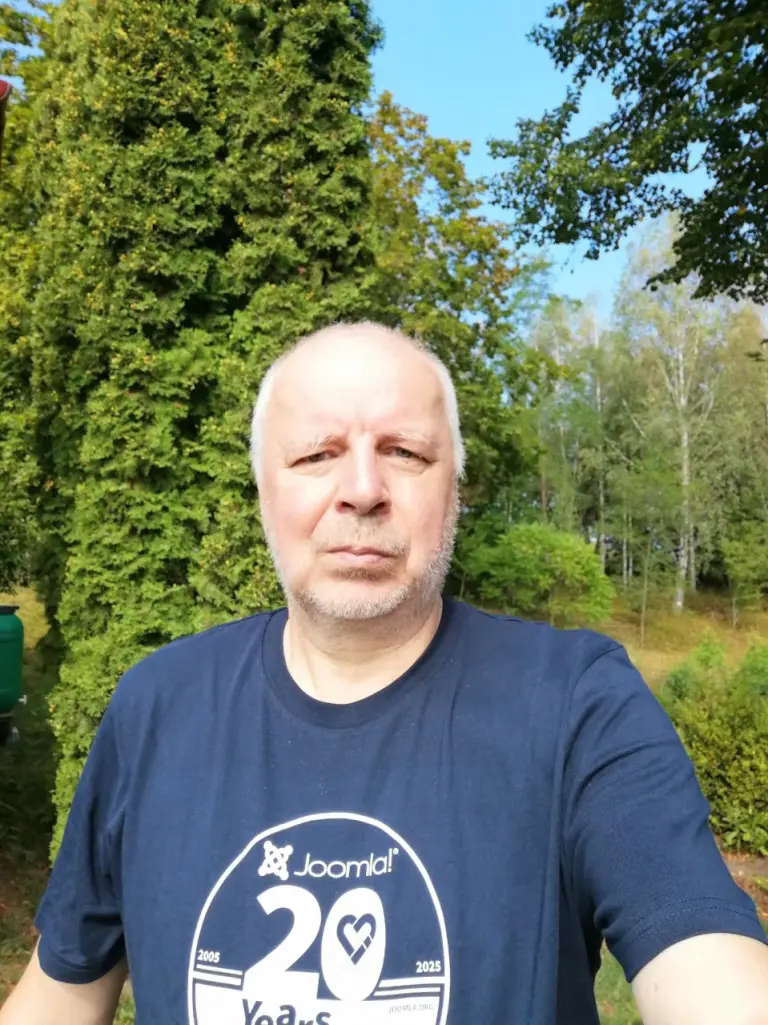 On photo: Dénes Székely
6. Why do you do this / what motivates you / what do you get out of it?
"Joomla wise makes my professional life easier."
Dénes
First of all, as I mentioned before, I am an open-source die-hard, I have been contributed to many successful open-source project, I am a “giver” if you like. I am believing in the force of the community, and I am sure, that helping each other with sharing the outcome of our work potentially can make this world a better place. And concretely, Joomla wise makes my professional life easier. I am using the code built by others for living. So, it is a natural thing for me to give back to community, as much as I can. It is not a big thing, but I feel that my little contribution still can make the difference.
7. What is the state of the e-commerce market in Romania? Which online payment systems are the most popular?
There are couple of local payment solutions which are the most used. Donát want to endorse here anyone, the point is that luckily, we have where to choose from. Romanian eCommerce market is kind of regional leader, here the eCommerce solution has been adopted earlier and used most as the regional average.
8. What key advantages of Joomla would you highlight?
Currently I think Joomla has the most logically built, capable core. Easy to adapt to your needs, easy to extend, easy to maintain. Needs a certain level of experience and knowledge to deploy and use, but the effort to learn it worth it.
9. Joomla turns 20. What are your thoughts on this milestone?
I hope that there will be a 40th birthday too – even if is not very likely to be part of it. Joomla has all the potential to reach that milestone.

From coders to content managers and from designers to developers: everyone in our community has had a starting point. And we all learn in different ways. Dénes Székely, for instance, started out as a programmer, created his first websites by using raw HTML and Javascript and discovered Mambo when he was looking for a way to manage a large, multilingual website.
Thanks for sharing your Joomla story with us, Dénes! Could you please tell us a little about yourself?
I live in a little town in Transylvania, Romania, named Csíkszereda in Hungarian (Miercurea-Ciuc in Romanian). And this small detail in my CV is an important detail, as you will see later on. I graduated from University as a physics engineer (specialising in nuclear fuels) and this is important in my story because this was the place where I made my first contact with computing - a medium building size IBM 360. Yeay! This was some years ago, fall of 1980 more precisely. After I graduated - and before the Chernobyl disaster happened - I decided that I am good without nuclear fuels, and ‘refurbished’ myself as a programmer by graduating a second masterate. Long story short, after some tumultuous years I ended up as the man who was supposed to introduce IT in everyday life in my hometown’s City Hall. Was fun, was challenging - and was rewarding.
Before I met the Internet 'in person' I had read a lot about it and was eager to use it, but it took some years until, in 1997, I was able to put together my very first server and began to make websites. Mostly for fun - at that time nobody understood what I was doing or whether this could be useful for anyone. I was the freak in some hidden little room in the back section of the city hall.
After I learned how to put together a basic website, I decided to make one for the city too. We were the second city in Romania to have a website, by the way. And at this point in my story, the place where I live becomes important. My city is one of the important Hungarian settlements in the middle of Romania. Yeah, it is a little known fact that Romania still has a significant Hungarian minority, representing around 8% of the population. But it is not the only minority here; in the Romanian Parliament there are 18 ethnic minorities represented beside the Hungarian one.
So, the website had to be multilingual. And that was a challenge. Using raw HTML and a little Javascript I did it and managed to obtain the Cool Site badge from the Open Directory Project (DMOZ, if someone still remembers…).
When did you make your first Joomla website?
We’re about to get to this too, but there are two important steps. First of all, over the years a raw HTML website of that size became very hard to manage - especially if you do it as your hobby. I began to search for a CMS I could use, a CMS that also supported building a multilingual site. WordPress was there, and I knew a lot about it, especially that it did not fit the bill. Back then it was basically impossible to build a multilingual site with (and it isn’t much easier even today). And this way I came across Mambo sometime mid 2002, just after the MOS - the Mambo Open Source (v 3.*) has been released, and MambelFish - the multilingual addon has become available. So the answer is tricky - I made my first Joomla site two years before Joomla forked out from Mambo ROTFL.
What made you choose Joomla?
Well, first of all I liked the concept, and the way it was programmed. I found my way around Mambo pretty fast, and began to develop all sorts of addons for it - mainly because there were things I needed to solve. Secondly, I liked the licensing model. At that time I had already a rich history in working on various Open Source projects and had a lot of code - and not just code - used by others, distributed on this model.
What did you do first, and after that?
First I built the site for the city. And discovered that there were a lot of missing pieces for it - from various addons to translations of the core and the components, snap-ins to make extensions built by others usable with MambelFish. Later I was hired by a local bookshop to build - well - an online bookshop for them, and this way I entered one of the dungeons of the web - the online shopping. Started with phpShop - which today has evolved to VirtueMart (I still have 2000 plus entries in VM’s support forum).
Can you describe the process of creating your first Joomla website?
Tough question. I experimented a lot, until I got a grip on how you could use Mambo to build a site, first of all. Created the plan for the site with a pencil and a paper sheet first, based on the site I had already in HTML and tried to carry it over to Mambo. And in the process I discovered what can be done - and most important, what can be done differently in a CMS. It took me almost a year until I began to be satisfied with the outcome - but every hour spent on the learning and experimenting was worth it.
And this happened almost at the same time with two important changes in my life - the fork from Mambo happened almost the same time when I left the City Hall and decided that I was going to try a career as a freelancer. I was tired of serving politicians and not being appreciated at all for the added value I put on the table. So, basically I have been a Joomla freelancer since Joomla 1.0.
What challenges did you face?
Basically I needed to reinvent the way I built websites (remember, I had 5 years behind me already), I had to find, to discover the tools I could use, to learn to use them properly, to find out how I could tweak them to serve my purposes - and how to fill the gaps with my own code.
It was a true manufacturing process, not like a pseudo-industrialized workflow, when you put together the individually bought/acquired parts, tighten the screws, pour some oil where needed, add some wax on top of everything, and you have a shiny, great looking, smoothly working website in a few. This is the best comparison that comes to mind, it’s like you try to compare how cars were built 100 years ago to what’s happening in the modern factories.
Every screw, bolt, cog you needed was either very hard to find - and most of the time you have found things of questionable quality, or you needed to manufacture it, on your own. Lots of spaghetti coding - and a couple of real gems, that was the general feeling.
How did you solve them?
In various ways. By asking around. By reverse engineering code written by others to understand how they did it. By using the forums and other formal and informal communication channels. By thinking and planning a lot, writing code and experimenting with it. There is no simple answer to these questions. Slowly, the ecosystem began to grow, the community became more and more colourful (in any sense of the word LOL), you could always find a helpful person, a code example, a good forum entry - and sometimes a good documentation or a valuable blog. And I liked this a lot.
Where did you get help?
First of all, in forums. Not only the official Joomla forum, but the individual developer’s forums, forums created to support a component, personal blogs. Over time I developed a network of people I could ask for advice - or give advice to as well. But up to date my best source of help is the code written by others - I am doing a lot of reverse engineering up to date. I know, it can be a waste of time and is less efficient than just buying an extension, but I like to do it. And I like to improve myself. Hence my tagline:
'Like a fine wine... Good from the start and getting better over time.'
